
How to Bargain in Mexico Like a Pro (and Have Fun Too!)

This post may contain affiliate links. If you make a purchase through them, we may earn a small commission (at no cost to you).
“Necklaces! Bracelets! Cheap Mexican junk!”
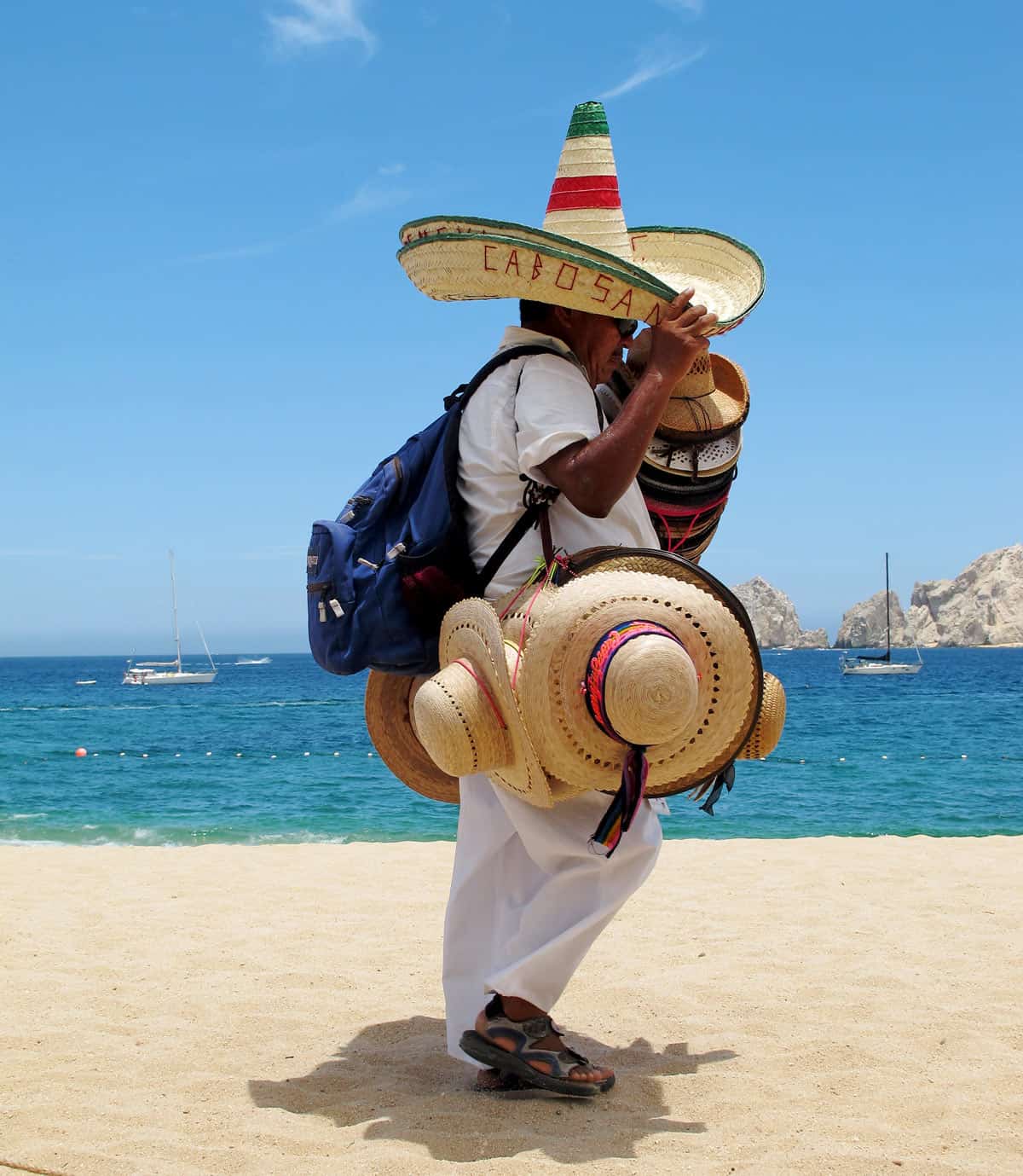
The singsong calls of the beach vendors are as much a part of Cabo San Lucas as the sun, sand and sea.
Day in and day out, you see the same good-natured men and women – dressed in white pants and shirts – traipsing along the sand, loaded down with their wares.
And here’s the thing… If you want to bring home a few cool Mexican souvenirs home, bargaining isn’t optional – it’s expected.
Indeed, learning how to bargain in Mexico not only gets you a better deal, it’s part of the fun!
Sure, haggling may feel awkward at first, but once you get into the rhythm, you’ll find it’s a playful dance. After all, bartering is woven into daily life here (just as it is in Thailand, Myanmar, and many parts of Asia).
Here are some tips on how to haggle, what you can buy and where bargaining is expected.
Featured reader comments
Bargaining in Mexico on the beach

Cabo San Lucas

Most of the vendors ply Medano Beach, one of the area’s most popular beaches.
(A few try their luck on the Corridor beaches in front of the major resorts; you rarely see a vendor on beaches on the Pacific side.)
On Medano Beach, you’ll find almost anything… Silver jewelry. Sun dresses, T-shirts, and sunglasses. Sombreros and cowboy hats. Colorful Mexican blankets. Temporary tattoos and hair braiding services. Decorative ceramic plates. Polished wood carvings of marlin and even bears.
You name it, they sell it!

But Los Cabos (aka Cabo) isn’t the only Mexican resort destination where shopping – and bargaining – happens right on the sand.
Puerto Vallarta
Over at Los Muertos Beach – the city’s busiest and most popular stretch of sand – vendors stroll up and down with their goods. In addition to crafts, they also sell food, like barbecued shrimp-on-a-stick and donuts.
Cancun and the Riviera Maya
You’ll mostly encounter beach hawkers on public stretches of the Riviera Maya, such as Playa Delfines in Cancun and Playa Mamitas in Playa del Carmen.
Within large all-inclusive resorts, however, vendors are usually kept off the property, so you’ll need to head to public beaches or into town for the experience.
Mazatlan
Mazatlan’s golden beaches are lined with vendors too. Expect everything from silver trinkets and colorful blankets to fresh oysters sold right from the sand.
Ixtapa
One exception is Ixtapa. The state of Guerrero prohibits beach hawkers there. Vendors can only sell in designated tourist markets, not on the sand.
How to say “no”

If you’re not interested in what the Mexican beach vendors offer, simply say “No thank you” or shake your head, and they’ll move on.
We’ve found the vendors in Cancun, in particular, to be pretty low-pressure.
Tip to avoid the vendors
In Cabo San Lucas, many resorts and bars on Medano Beach have roped-off areas for guests, where passing vendors can’t cross.
Pick a spot behind the rope if you don’t want to be bothered.
How to bargain in Mexico like a pro

But if you’re keen and want to take a closer look, the vendor who’s caught your eye will spread their goods out on a blanket on the sand, or display their silver jewelry in an open suitcase propped up on a little stand.
Then the bargaining begins.
Remember, the vendor is happy to bargain with you. They want you to engage with them, and the bargaining should be fun.
You could start by offering half of the asking price.
But the vendor might act offended.
For sure, they will say no and come back at you with something higher than your offer, but lower than their first ask.
One of the best bargaining tips?
Start to walk away. You’ll find out pretty quickly how low the vendor will go.

Expect in the end to pay about 30% less than the top asking price.
If you’re tough, you might even get away with a 50% discount.
But it’s not all about squeezing the last peso out of the vendor, right?
In this delightful story on “How to Bag a Bargain in Mexico,” travel writer Marie Javins was even prepared to pay full price for a hand-embroidered Otomi textile in the colonial town of San Miguel de Allende.
But she was bargained down by the grandpa who had sewn it.
Tourism is what makes Mexico’s resort destinations tick, and bargaining in Mexico and selling wares is how vendors make their living.

The bargaining should be fair
The current exchange rate is about 19 pesos for one U.S. dollar or 14 pesos for one Canadian dollar. (Check the rate at the time you go.)
Vendors take U.S. dollars. But you’re usually better off to pay in pesos.
Bottom line? If you’re happy with the price, it’s a good deal. And you’ll take home a nice little memory of your Mexico vacation.
Shopping in Cabo San Lucas on the beach
Oh, the souvenirs from Cabo we’ve bought!
Carved wooden bears
Yes, George has bought bears, even though we don’t believe Mexico is home to bears.
George couldn’t resist, since black bears often wandered down from the mountains and roamed around our old Vancouver neighborhood.
Silver bracelets, earrings and ankle bracelets
Buying silver is a bit tricky in Mexico on the beach – but we’ve bought lots of it!
Only one bracelet has ever broken; unfortunately that was a gift to Janice’s best friend, so we promptly had to buy her another on the next trip to Cabo.
If you’re really into silver, Taxco (one of the beautiful colonial silver cities in Mexico) is the place to go.
T-shirts
We’re walking advertisements in the gym with our “Cabo!” T-shirts.
Mexican blankets
One fell apart in the washing machine, but we still use three others as throws in the house (good for snuggling in when watching TV).
Ceramic plates
We had to lighten the load of one of the vendors pictured here :-).
Beach wraps
Great for covering up, they also double as tablecloths when we go on picnics.
What about you?
What have you bought? Let us know in the Comments below! We love hearing from readers…
Experience more of Mexico!
Find this helpful? Then pin it!


Our top travel tips and resources
→ Hotels | Booking.com is our go-to for scoring a “wow” hotel – or at least a decent one – often at lower rates than the hotel’s own website. (We especially like Booking.com’s flexible cancellation policy!) You can also find excellent discounted rates on Expedia, especially for hotels in the U.S. and Mexico.
→ Vacation homes, condos and rentals | We prefer and use Vrbo (Vacation Rentals by Owner).
→ Flights | For the best flights, we search on Google Flights first. Expedia and Kayak are then perfect for snagging the cheapest tickets. (They’re often non-refundable, though, so for more flexibility, we book directly with the airline, even if it costs more.)
→ Airport lounge access | We love (and have) Priority Pass for comfy lounge seats, free snacks and drinks, complimentary WiFi and sometimes even showers and spa services!
→ Tours | For the best local food, walking and other guided tours, plus skip-the-line tickets to attractions, check out Viator (a TripAdvisor company) and GetYourGuide.
→ Car rental | Renting a car can be a great way to explore off the beaten path. Discover Cars searches car rental companies for the lowest rates.
→ Travel insurance | SafetyWing is designed for frequent travelers, long-term adventurers and digital nomads. It covers medical expenses, lost checked luggage, trip interruption and more. We also have and recommend Medjet for global air medical transportation.
→ Travel gear | See our travel shop to find the best luggage, accessories and other travel gear. (We suggest these comfy travel sandals for city walking, the beach and kicking about.)
→ Need more help planning your trip? | Check out our travel tips and resources guide for airline booking tips, ways to save money, how to find cool hotels and other useful trip planning info.
If you make a booking or purchase through our site, we may earn a small commission (at no cost to you). Thanks!
Photo credits: © Janice and George Mucalov, SandInMySuitcase (except #1)
About the authors

The picture on one of the photographs are bathroom sinks, not plates…
Hi PJJ,
You’re right – good eyes! Those sinks are so colorful and decorative, it’s hard to believe they’re actually bathroom sinks… Anyway, we’ve changed the caption :-).
Thanks for reading and pointing this out :-).
This is a good post.
This is something a lot of tourists don’t know how to do because it isn’t a thing in the United States. However it’s normal in a lot of Spanish speaking countries.
The unfortunate thing is that if a local sees you’re a tourist, there’s a big chance you’re going to get a high asking price for what you are trying to buy.
You’re right, Alyssa, most tourists are going to pay more than locals. It helps that tourists are usually okay with this; they earn more than locals and have more spending money – and they’re still paying less than what it would cost to buy the item back home in the U.S. or Canada :-). Thanks for chiming in!
This is so helpful! I haven’t been to any of these destinations yet but they’re on my list. I love the items in your photos too so I’ll definitely need the bargaining info. Thank you for the helpful tips. I also love the way this shares a way of life and keeps it alive.
If you haven’t bargained before, it can be a bit awkward :-). And you’ll love the Mexican beach destinations mentioned here…
I really enjoy reading this article. Unfortunately I’ve never been so good at bargaining although I live on the Balkans – in Bulgaria, to be more precise. But I enjoy watching my friends doing it. You have to be clever and to think faster than the trader. It’s funny.
Thanks for sharing what it’s like in the Balkans! Bargaining is a bit strange for us Canadians too, because we’re not used to it. Shopping is all “fixed price” — unless you go to a garage sale at someone’s house :-).
These are some excellent tips on bargaining on the beach everywhere in the world, not only in Mexico. Very enlightening and informative post, Janice and George!
Thanks Agness!
Love this! I used to go to Mexico with my family as a child, and my parents always told me to bargain at the markets!
It’s quite fun too, once you get used to the idea. The only problem is when you return home and ask a store if they can offer a discount or a better price, they look at you strangely.
I think over the past 12 months the closest thing to bargaining we’ve done is over the price of a cab ride in Laos that still cost way more than it should have done for a local.
We don’t really buy much whilst we’re on the go as we like to count our photographs and memories as souvenirs, but should we see something when we (hopefully) see Mexico next year, we’ll be clued in a lot more to get a fair price for what we’re after.
No doubt every traveler has overpaid for a cab ride at least once! Just take comfort in knowing that you helped support the local Laos economy :-). And when you get to Mexico, have a great time (the people really are very warm and friendly).
Janice and George, I’m glad you found that they will leave you alone once you say “no” when you were in Cabo. Because in Ensenada they would not leave you alone after telling them “no”. It made for a horrible experience off of our dinner cruise.
That’s too bad. It isn’t fun when you feel “pestered.” Sometimes you have to say “no” a couple of times to some vendors in Cabo, but they do usually say, “Ok, amigo, maybe tomorrow” and leave you alone.
Great tips and wonderful pictures! I can’t resist a store that comes to you while you’re sipping a margarita on the beach!
Pretty easy shopping, isn’t it? Even beats buying online!
We bought the bears as well (and much, much more)! We love them – only thing was that when we came back to Canada, customs held us back to inspect the wood items!
Oh, that’s so funny – they must carve the bears for us Canadians! Hopefully you eventually got your bears back from customs :-).